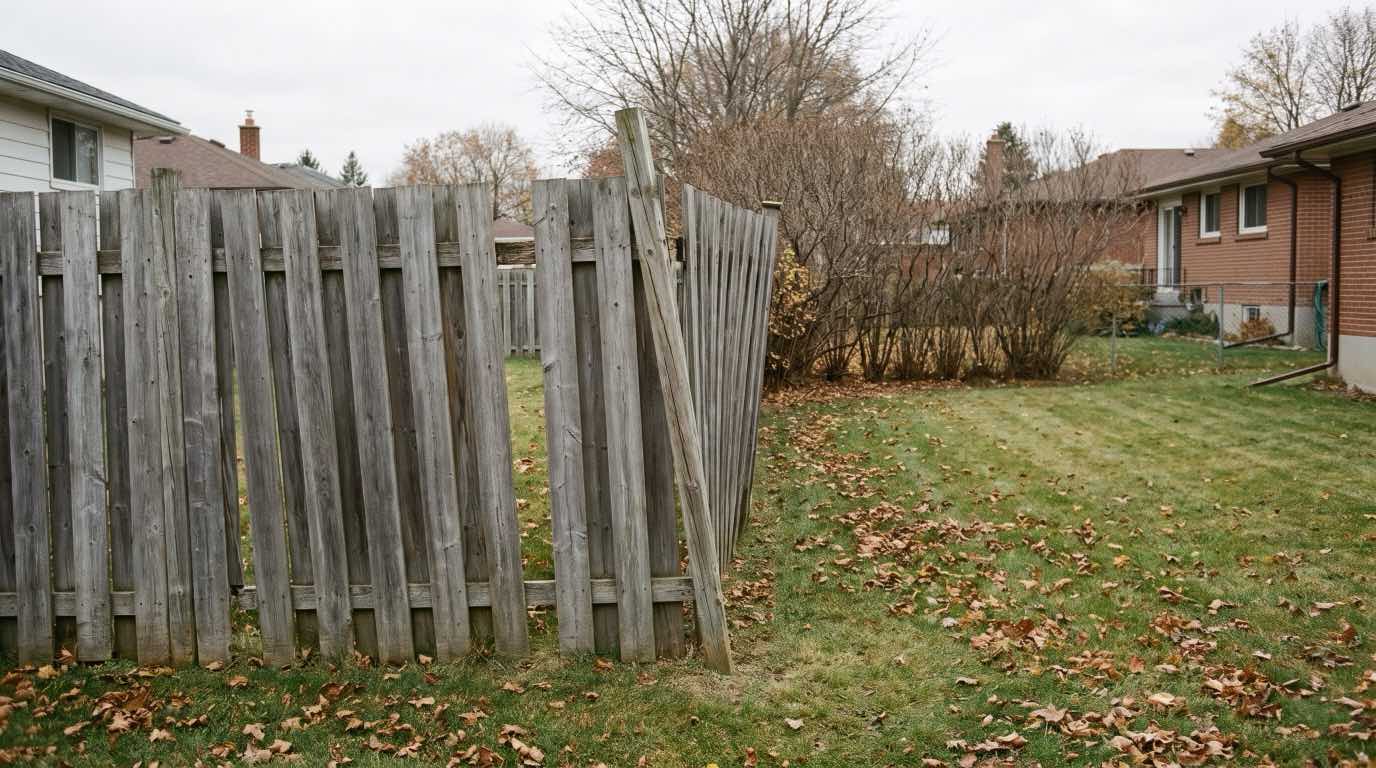
Who pays for the fence between my property and the neighbour?
Most people treat a shared fence as a negotiation with the neighbour. There is an actual procedure behind it, run by the municipality, and the result can end up attached to the property itself.
The short answer
Ontario has a statute for this. Where it applies, an owner can ask the municipal clerk to send fence-viewers, who arbitrate and make an award, and the default is that each side carries one-half. Robin Patel, a REALTOR® in the Greater Toronto Area, checks whether an award is attached to the land.
Written forOwners and buyers in the GTA facing a boundary fence that needs replacing where the neighbour will not share the cost, and anyone told that a fence dispute is simply a private matter between the two owners.
The short version
- The Line Fences Act sets out a procedure for deciding what portion of a boundary fence each adjoining owner must build, repair and maintain.
- An owner starts it by notifying the clerk of the local municipality using the prescribed form, asking for fence-viewers to view and arbitrate.
- Three fence-viewers examine the premises, may hear evidence on oath, and make an award signed by any two of them.
- The default in an award is that each owner carries a designated one-half, unless the fence-viewers consider that unjust and award otherwise.
- The Act does not apply to land in an area subject to a by-law under the Municipal Act or the City of Toronto Act, so check your municipality before relying on it.
There is a statute, and most people never hear about it
A shared fence is usually treated as a private negotiation, and when the neighbour says no the conversation tends to stop there. Ontario has a dedicated Act for exactly this situation, and it does not depend on the neighbour agreeing to anything.
The Line Fences Act gives an owner who wants a boundary fence constructed, repaired or reconstructed a route that runs through the municipality rather than through the courts. The owner notifies the clerk of the local municipality using the prescribed form, asking for fence-viewers to view and arbitrate what portion of the fence each owner must construct, reconstruct or repair and maintain.
Ontario has a dedicated Act for exactly this situation, and it does not depend on the neighbour agreeing to anything.
Where the Act steps aside
This is the part that decides whether anything else here is useful to you. The Act provides that it does not apply, except for one section, to land in an area that is subject to a by-law passed under the relevant provision of the Municipal Act, 2001 or of the City of Toronto Act, 2006.
In plain terms, a municipality that has legislated its own fence regime takes the area out of this procedure, and the municipal by-law governs instead. Whether that has happened where your property sits is a question for your municipality, and it is worth confirming directly rather than assuming, because that is precisely the kind of local fact that changes.
What the procedure actually looks like
Three fence-viewers examine the premises, and if either adjoining owner requires it they hear evidence and may examine the owners and their witnesses on oath. It is an arbitration carried out on the ground rather than a paper exercise.
They then make an award in the prescribed form, signed by any two of them, which states that a fence shall be constructed, reconstructed or repaired and maintained to mark the boundary, and specifies the location of the fence and the description of it.
| Step | What the Act says |
|---|---|
| Starting it | The owner notifies the clerk of the local municipality using the prescribed form |
| Who decides | Three fence-viewers examine the premises and may hear evidence on oath |
| The outcome | An award in the prescribed form, signed by any two of them |
| The default split | Each owner carries a designated one-half, or one builds and the other pays one-half of the costs |
| Where that is unjust | The fence-viewers may make such award as they consider appropriate |
| What they weigh | The benefit to both owners of having the boundary marked, the nature of fences in use in the area, and any other relevant factors |
| Appeals | The Minister appoints a referee for the purposes of the Act |
Why this turns into a title question
An award is not just a decision about a fence. Where an amount is certified under the Act and remains unpaid, the Act provides that it may be collected in the same manner as municipal taxes and is, until collected or otherwise paid, a charge upon the land liable for payment of it.
That is what moves this off the neighbour's side of the ledger and onto the property's. A dispute that was somebody else's argument can arrive as an amount attached to the land you are buying, which makes it a question for your lawyer during the condition period rather than a conversation to have after closing.
Written by
Robin PatelSalesperson · The Agency Toronto
Updated
Published
Read in your language
A machine translation, not Robin’s words. For anything that decides money, ask him in Gujarati or Hindi directly.